
A Unified
Operating Group
Complex organisations slow down when execution scatters across teams and vendors. Control weakens as decisions lose a clear owner and accountability spreads thin. Ascella Group brings structure to execution by aligning responsibility, governance, and delivery under one operating layer.
Execution breaks when responsibility spreads across teams, vendors, and functions. Work continues, effort stays high, yet outcomes drift. Decisions slow, risks surface late, and delivery feels unstable. The failure sits in structure and ownership, not effort or intent.
The Execution Problem Modern Organisations Face
The Execution Problem Modern Organisations Face
Execution Policy
Execution Policy
Diffuse Ownership
No single accountable owner
Work moves across roles and partners without a clear decision holder, forcing coordination to replace authority and causing outcomes to drift despite visible activity.
Priority Drift
Effort without shared direction
Teams execute against local goals instead of common outcomes. Work advances in parallel but pulls in different directions. Results weaken as alignment stays informal.
Leadership Drain
Focus lost to coordination
Senior leaders spend time resolving handoffs and conflicts. Strategic work gives way to operational fixes. Energy drains as execution lacks structure.
Diffuse Ownership
No single accountable owner
Priority Drift
Effort without shared direction
Leadership Drain
Focus lost to coordination
The programme focuses on embedding operating
discipline before scale introduces complexity.
Central Decision Engine
A single decision authority receives inputs, sets priorities, and signs off on trade offs.
Roles and responsibilities map to outcomes, not tasks. Escalation follows a clear path so issues reach the right level fast. This reduces overlap and speeds delivery.
Named Accountability
Every critical control has an accountable person and a documented remit.
Work packages include named owners, acceptance criteria, and delivery milestones. Status becomes factual, not noisy, because responsibility is visible. That visibility shortens feedback loops and limits scope creep.
Control Gates
Release and change gates require explicit approvals tied to risk and impact.
Each gate has standard evidence, owners, and timelines. Decisions either progress work or resolve blockers before impact widens. The result is steadier operations and fewer emergency escalations.
The programme focuses on embedding operating discipline before scale introduces complexity.
Central Decision Engine
A single decision authority receives inputs, sets priorities, and signs off on trade offs.
Roles and responsibilities map to outcomes, not tasks. Escalation follows a clear path so issues reach the right level fast. This reduces overlap and speeds delivery.
Named Accountability
Every critical control has an accountable person and a documented remit.
Work packages include named owners, acceptance criteria, and delivery milestones. Status becomes factual, not noisy, because responsibility is visible. That visibility shortens feedback loops and limits scope creep.
Control Gates
Release and change gates require explicit approvals tied to risk and impact.
Complexity grows faster than controls when scale outruns governance. Clear gates keep delivery steady as scope expands.
Complexity grows faster than controls when scale outruns governance. Clear gates keep delivery steady as scope expands.
Security & Risk Posture
Security and risk posture focuses on keeping organisational risk visible and controlled. Security decisions link directly to business priorities and acceptable risk levels. Each control has a clear owner, review cycle, and response plan. This reduces surprises and limits the impact of incidents when issues occur.
Technology Execution
Technology execution ensures systems work reliably as change increases. Platforms follow clear build, release, and run standards. Ownership stays consistent across development and operations to avoid gaps. This keeps delivery steady and reduces failures during growth.

Workforce Readiness
Workforce readiness prepares teams for real operating conditions. Roles and escalation paths stay clear before pressure hits. Training reflects actual scenarios instead of theory. Teams respond faster and make better decisions during incidents.
Operational Control
Operational control brings structure to daily execution. Decisions follow defined paths instead of informal coordination. Signals focus on risk, progress, and dependencies. Work becomes predictable and less reactive over time.

Revenue Enablement
Revenue enablement connects execution quality to business results. Technical priorities reflect revenue impact and customer trust. Launches follow readiness checks and clear success measures. Growth stays protected as execution becomes disciplined.
OWNERSHIP
Security & Risk Posture
Security and risk posture focuses on keeping organisational risk visible and controlled. Security decisions link directly to business priorities and acceptable risk levels. Each control has a clear owner, review cycle, and response plan. This reduces surprises and limits the impact of incidents when issues occur.
Technology Execution
Technology execution ensures systems work reliably as change increases. Platforms follow clear build, release, and run standards. Ownership stays consistent across development and operations to avoid gaps. This keeps delivery steady and reduces failures during growth.
Workforce Readiness
Workforce readiness prepares teams for real operating conditions. Roles and escalation paths stay clear before pressure hits. Training reflects actual scenarios instead of theory. Teams respond faster and make better decisions during incidents.
Operational Control
Operational control brings structure to daily execution. Decisions follow defined paths instead of informal coordination. Signals focus on risk, progress, and dependencies. Work becomes predictable and less reactive over time.
Revenue Enablement
Revenue enablement connects execution quality to business results. Technical priorities reflect revenue impact and customer trust. Launches follow readiness checks and clear success measures. Growth stays protected as execution becomes disciplined.
Execution Arms
We take full responsibility for critical outcomes that organisations cannot afford to fragment
Ascella Infosec
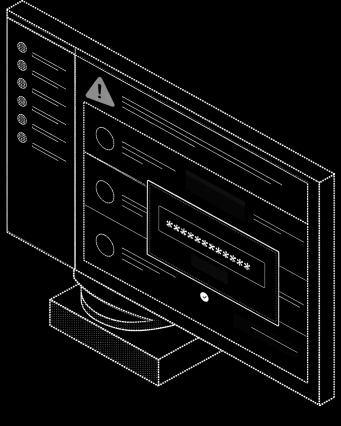
Ascella Infosec focuses on protecting organisations from operational and regulatory risk. Security work stays tied to business priorities, not checklists. Controls, audits, and response plans sit under clear ownership and review cycles. Exposure reduces because risks surface early and decisions stay accountable.
Outcome: Reduced exposure and regulatory confidence.

How We Operate
Control is designed in,
not enforced later
Ascella establishes governance, accountability, and measurement before execution begins ensuring delivery remains controlled, predictable, and aligned as organisations scale.
- 01
Structured authority
Decision ownership stays defined from the start, with clear authority and outcome responsibility assigned to specific roles instead of shared committees.
- 02
Outcome pods
Small cross functional teams own defined results within a shared operating system, which reduces handoffs and keeps accountability intact throughout delivery.
- 03
Operational signals
Progress, risk, and dependencies remain visible through a small set of consistent signals that surface issues early and trigger action.
- 04
Built in security
Risk consideration stays embedded in planning and execution workflows, which reduces exposure and prevents last minute controls or reactive fixes.
How We Operate
Control is built before
work begins
Ascella establishes governance, accountability, and measurement before execution begins...
Structured authority
Decision ownership stays defined from the start, with clear authority and outcome responsibility assigned to specific roles instead of shared committees.
Who We Work With
Organisations that require control, accountability, and structured execution at scale
Startups
Early teams need speed without long term damage.
Lightweight structure prevents chaos as headcount and complexity grow. Execution stays focused while foundations remain strong.
FAQs
Frequently Asked Questions
Common questions about how Ascella works, what it owns, and how engagements run. Written to help assess fit and set expectations early.

What is Ascella Group?
What is Ascella Group?
Ascella Group works across cybersecurity, technology, marketing, branding, and GTM, helping organisations manage these areas with clarity and accountability instead of fragmentation.
Is Ascella a consulting company?
Is Ascella a consulting company?
Ascella is not a consulting firm. Work does not stop at advice or recommendations. Responsibility extends into execution, governance, and outcomes.
Is Ascella an agency or vendor?
Is Ascella an agency or vendor?
Ascella is not positioned as an agency or a service vendor. Execution happens under a single operating authority with ownership retained through delivery.
Does Ascella replace internal teams?
Does Ascella replace internal teams?
Ascella does not replace internal teams. It provides structure, decision clarity, and control so internal teams can execute more effectively.
When does Ascella typically get involved?
When does Ascella typically get involved?
Engagements usually begin when execution becomes hard to manage across teams or vendors and ownership starts to blur.
Does Ascella work with existing vendors?
Does Ascella work with existing vendors?
Yes. Existing vendors remain in place when useful. Ascella coordinates and governs their work to reduce fragmentation.
FAQs
Frequently Asked Questions
Common questions about how Ascella works, what it owns, and how engagements run. Written to help assess fit and set expectations early.
Ascella Group works across cybersecurity, technology, marketing, branding, and GTM, helping organisations manage these areas with clarity and accountability instead of fragmentation.
Ascella is not a consulting firm. Work does not stop at advice or recommendations. Responsibility extends into execution, governance, and outcomes.
Ascella is not positioned as an agency or a service vendor. Execution happens under a single operating authority with ownership retained through delivery.
Ascella does not replace internal teams. It provides structure, decision clarity, and control so internal teams can execute more effectively.
Engagements usually begin when execution becomes hard to manage across teams or vendors and ownership starts to blur.
Yes. Existing vendors remain in place when useful. Ascella coordinates and governs their work to reduce fragmentation.
Initiate an alignment-led
engagement process.
Not sure where to begin?
Initial engagement focuses on alignment, not sales discussions.
hello@ascella.groupBegin alignment Execution follows.
The first step focuses on clarity and fit.
+91 16045 10860